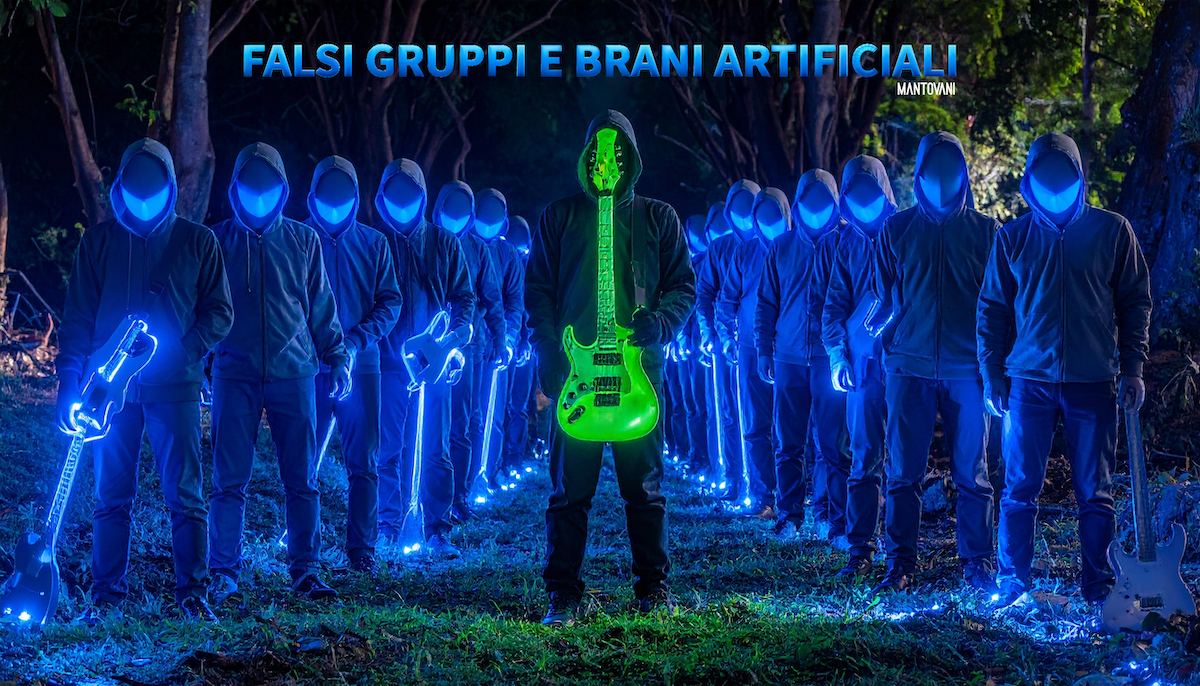
Songs created with artificial intelligence are no longer just ambient carpets or electronic loops: today, fake rock, salsa or jazz groups that never really existed are swarming on YouTube and Spotify.
Let's take Rumba Congo (1973), a “album” loaded on YouTube together with the detailed biography of the phantom band Concubanas: born in Havana in 1971, disbanded in 1992 after leaving a trail of masterpieces that fuse Cuban and Congolese rhythms. Only at the end of the description do we discover that the band is fictitious – a euphemism for saying that those songs were generated entirely by an algorithm.
Listening to the tracks, between salsa, rumba and son, an untrained ear would struggle to guess that behind it there is only a prompt. Today platforms like Suno, Boomy and Udio allow you to create surprisingly convincing pieces of jazz, rock and hybrid genres, going beyond the simple “musica da sottofondo” for study or relaxation.
A booming market
A study by the International Confederation of Societies of Authors and Composers estimates that AI music revenues will rise from 100 million euros in 2023 to 4 billion in 2028. By that date, it is expected that 20% of streaming platforms' revenues will come from artificially generated content
The issue of transparency
For María Teresa Llano, a professor at the University of Sussex who researches the relationship between creativity and AI, the real problem is the lack of clarity: «Non esiste un modo semplice perché l’ascoltatore capisca se un brano è stato creato da un umano o da un algoritmo. La responsabilità di garantire trasparenza è ancora “in aria”».
Discontent is growing on Reddit and various streaming forums. A post in the Spotify community is clamoring for clearly visible labels for AI music and the ability to filter its presence. Many users speak of a feeling of deception; others, on the contrary, admire the technological progress. Llano herself, a Colombian who grew up on salsa ritmo, confesses: «Quando ho ascoltato Rumba Congo l’ho trovato convincente. Scoprire che era finto mi ha affascinata, ma ha tolto un po’ di magia».
Why should we care – or maybe not?
- Platform saturation With generators increasingly accessible, the influx of AI tracks risks swamping traditional releases, complicating the discovery of new real talent.
- Copyright and Revenue Sharing If 20% of revenues went to entirely synthetic tracks, how would the proceeds be redistributed among human artists, template developers, and platforms?
- Evolution of Taste Will audiences learn to distinguish? Or will the average quality decline until a new standard of certified authenticity emerges?
At the same time, just as drum machines didn't destroy but revolutionized pop music, AI could open up new creative avenues, becoming a tool at the service of musicians rather than a rival.
The Next Step is Yours
If you are an artist who wants to stand out in this rapidly evolving landscape—and perhaps integrate AI into your creative process without losing your identity—contact me: let's set up a meeting and plan your musical career together.
Book a meeting with me to discover concrete strategies to improve the performance of your music on streaming platforms.