

We are used to being copied. And if people copy us, we must be doing something right. But there is one thing I will not accept: an artist mistaking a copy for our work and entrusting their music, budget and confidence to someone outside our group.
I have no problem with competition. I have a problem with people reproducing the wording, content and presentation of our projects without establishing a recognisable identity of their own. And with a market that asks artists for trust without making clear who is on the other side.
That is why I am publishing names, addresses and screenshots. Classifica Radio Italia, Musica Italiana Top, SPC Music Publishing and RadioSender do not belong to Mantovani Group. They are not our services and should not be confused with Classifica Indie, Classifica Italiana or Monitor Radio.
You cannot copy our work with a homepage
Our platforms represent years of work and significant financial investment: people, technical staff, servers, databases, development, support and maintenance. There are business costs and responsibilities we take on every day.
A chart needs updating. An airplay service needs to collect and manage data. Errors must be identified and corrected. Customers need someone who answers for the service sold. That part does not appear in a screenshot, but it makes the difference.
Reproducing wording or recreating a design does not mean building what stands behind it. I am concerned that an artist might recognise a familiar layout and give it the trust they have in our group. That trust is not transferable.
Classifica Radio Italia: the wording from our projects
The first website is classificaradioitalia.com. Its “Metodologia” section contains this wording, which we use to describe our charts:
Classifica per indice di gradimento generata mediante l’accurata analisi dei portali che si occupano delle uscite dei singoli, del volume dello streaming web e del numero di emittenti che trasmettono i brani.
This is not a loose similarity in subject matter. The wording appears word for word. Here is the screenshot.
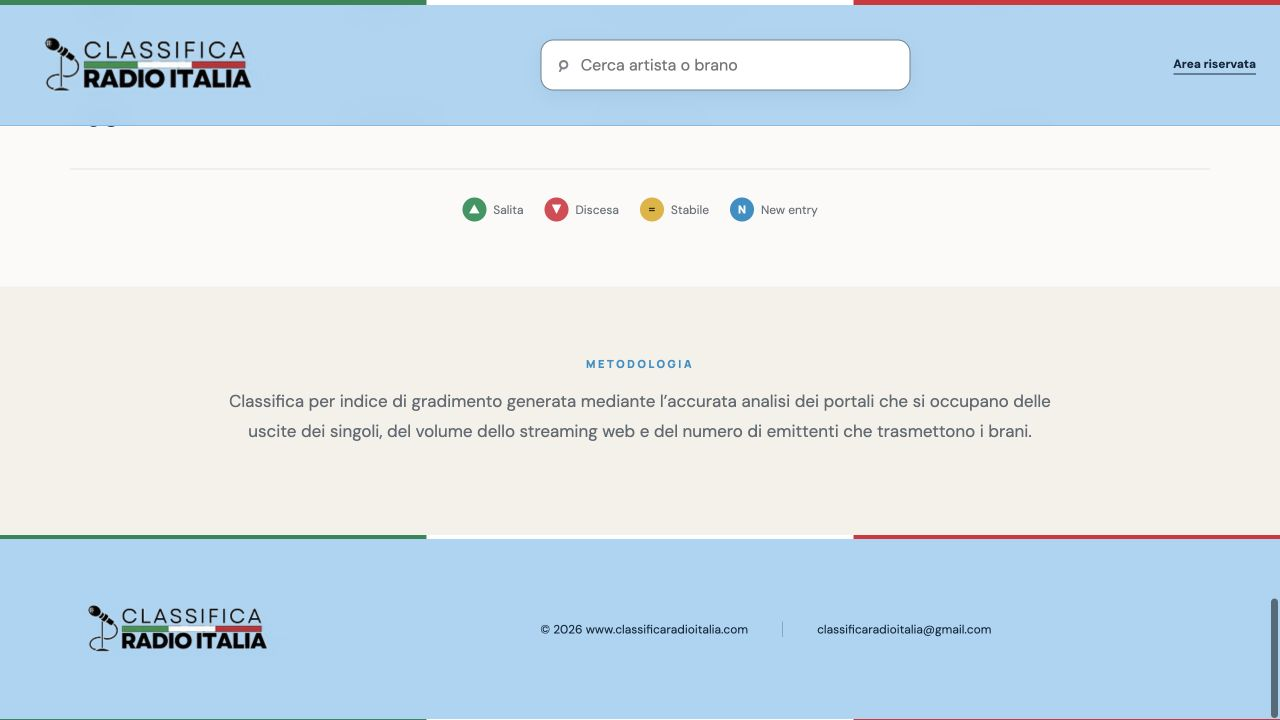
On the homepage and footer checked, I did not find a complete legal business name, address, VAT number or links to service terms. I found a Gmail address. That is not enough for me: an email alone does not identify the party responsible for what is published or offered.
The name can cause confusion, so let me repeat: Classifica Radio Italia is not our Italian Chart or Indie Chart. Use our official domains to consult our data.
Musica Italiana Top: twenty songs in the same order
The second case concerns Musica Italiana Top and its “Classifica Indie Italiani” page. Its table updated on 6 October 2026 contains the same twenty songs, in the same order, as the first twenty positions of our Classifica Indie updated on 5 October.
From “Genova e Napoli” to “Matto di te”, the sequence matches. Changing some spellings or the presentation does not make that correspondence irrelevant. I want clarity about where the data comes from and the relationship with its source. Compare the opening positions below.
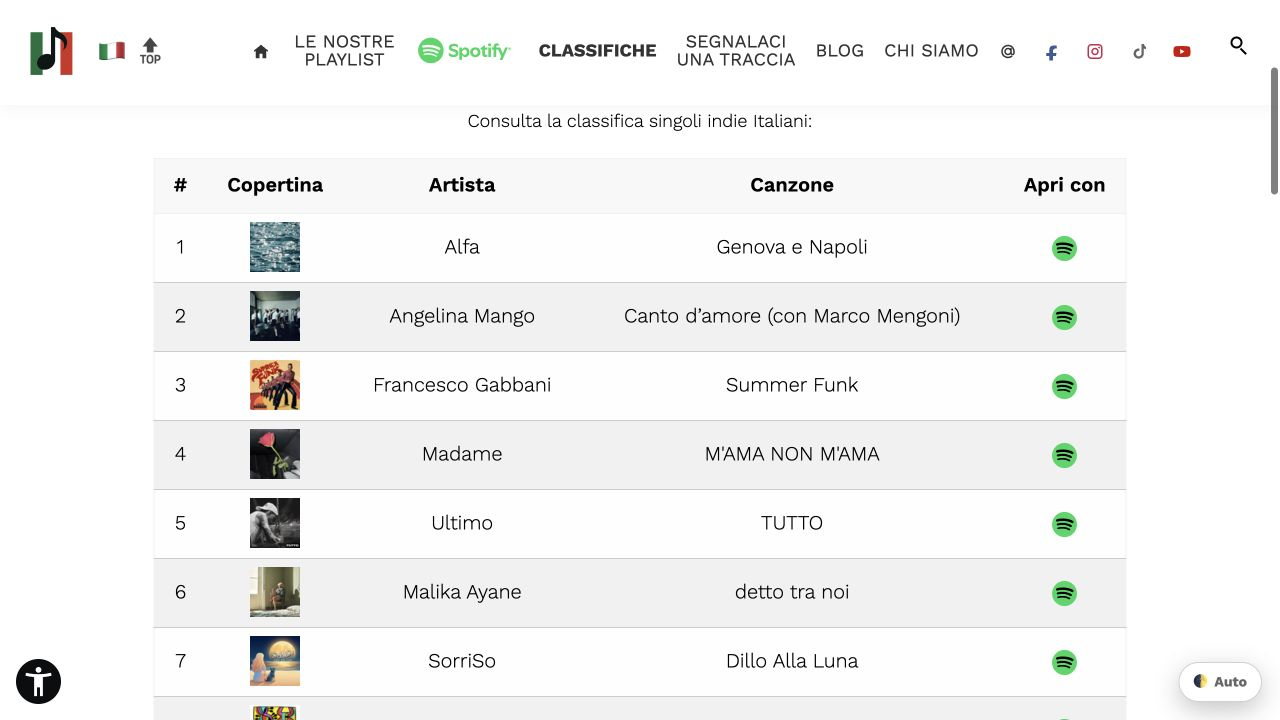
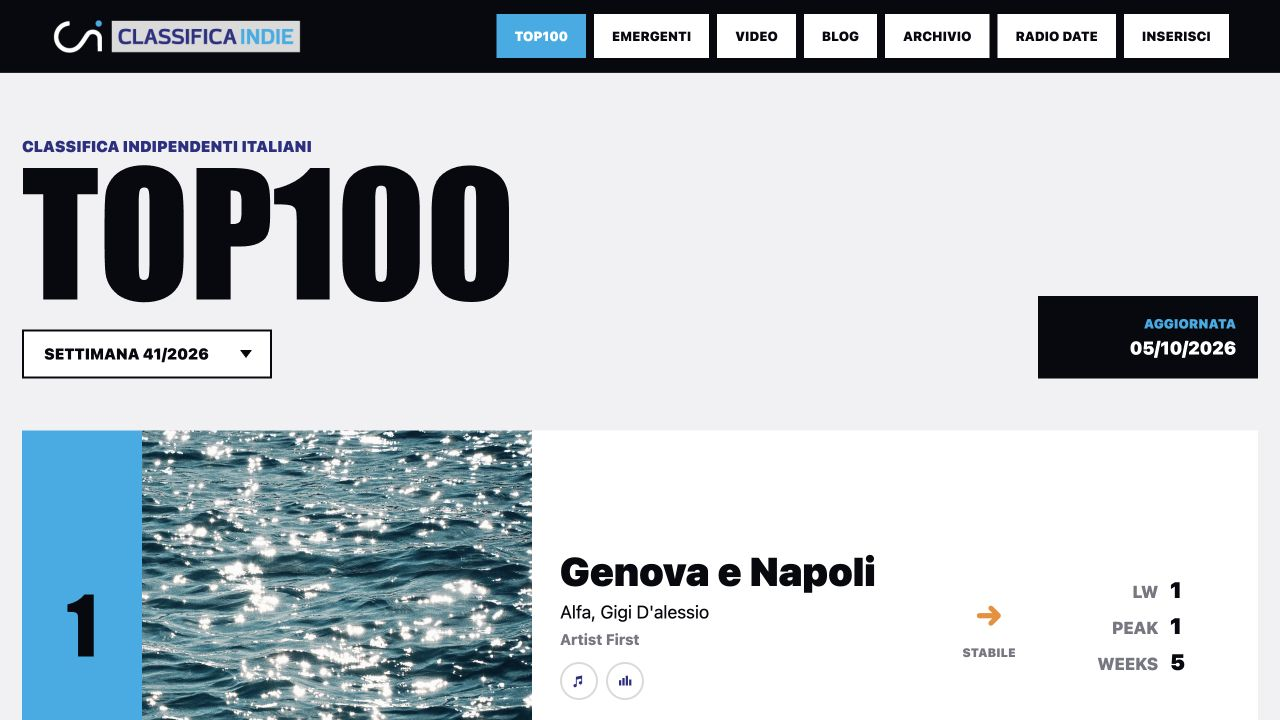
On the chart, “Chi siamo” and privacy pages checked, I did not find a complete legal name accompanied by an address and VAT number. There are contacts and social profiles, but a website name alone does not identify a business. “Chi siamo” describes playlist inclusion as free; the issue raised here concerns chart provenance and transparency of identity.
SPC Music Publishing and RadioSender: compare the pages
The third case concerns SPC Music Publishing and the RadioSender service linked from its website. Its panels, search, radio showcase and Radio Date sections contain visual choices that closely remind me of our Monitor Radio.
I am publishing both screenshots so you can compare them directly.
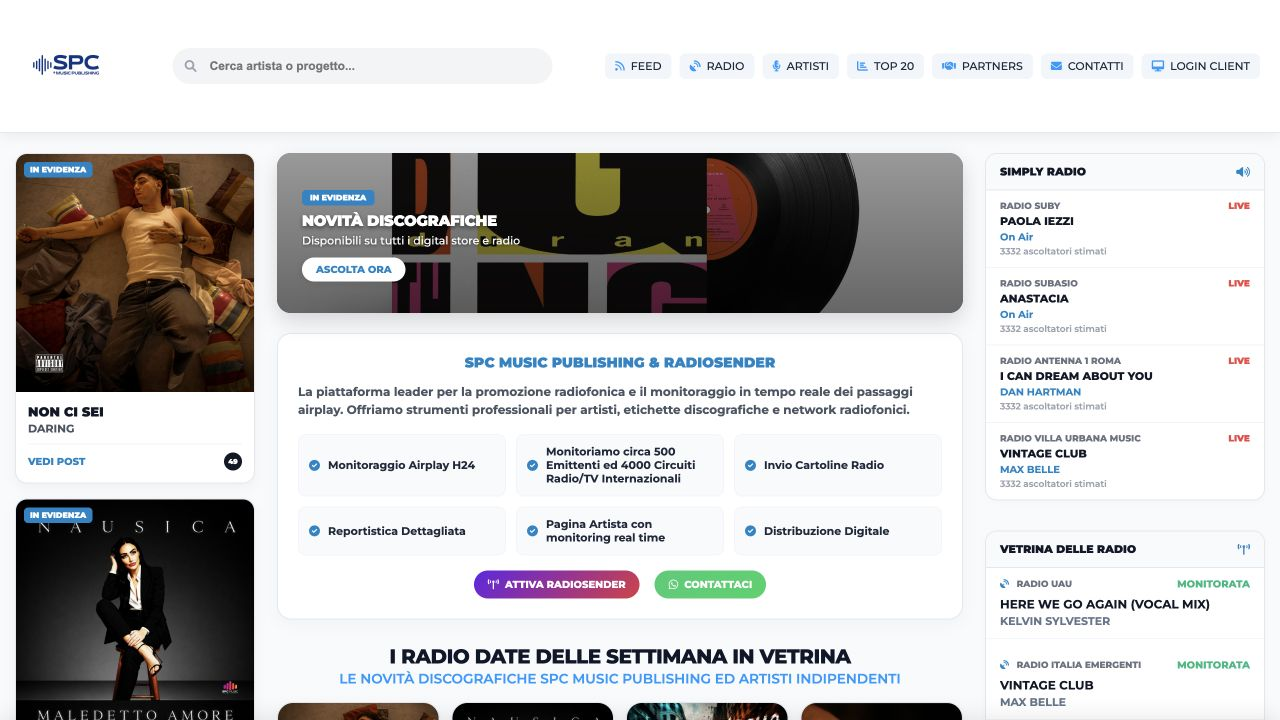
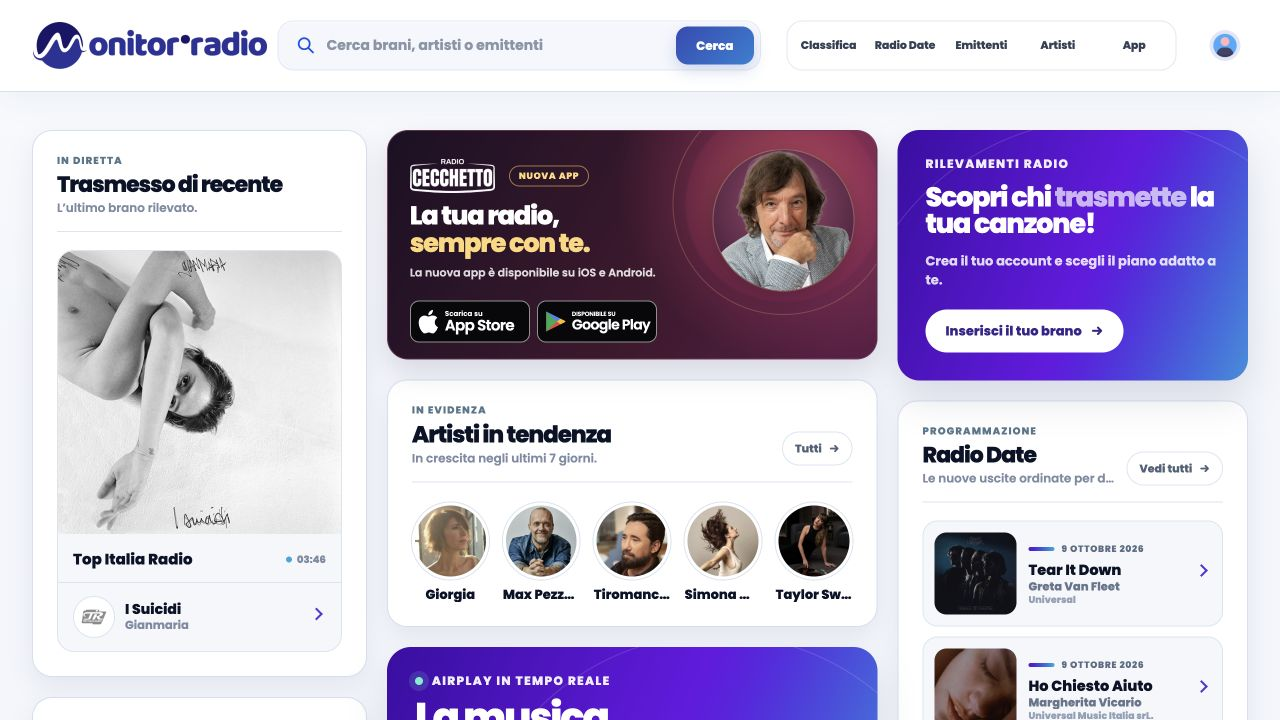
The RadioSender commercial page advertises an offer at €80 per track. On the SPC homepage, its “Contatti” page and the landing page checked, I did not find complete company and tax details or links to sales terms.
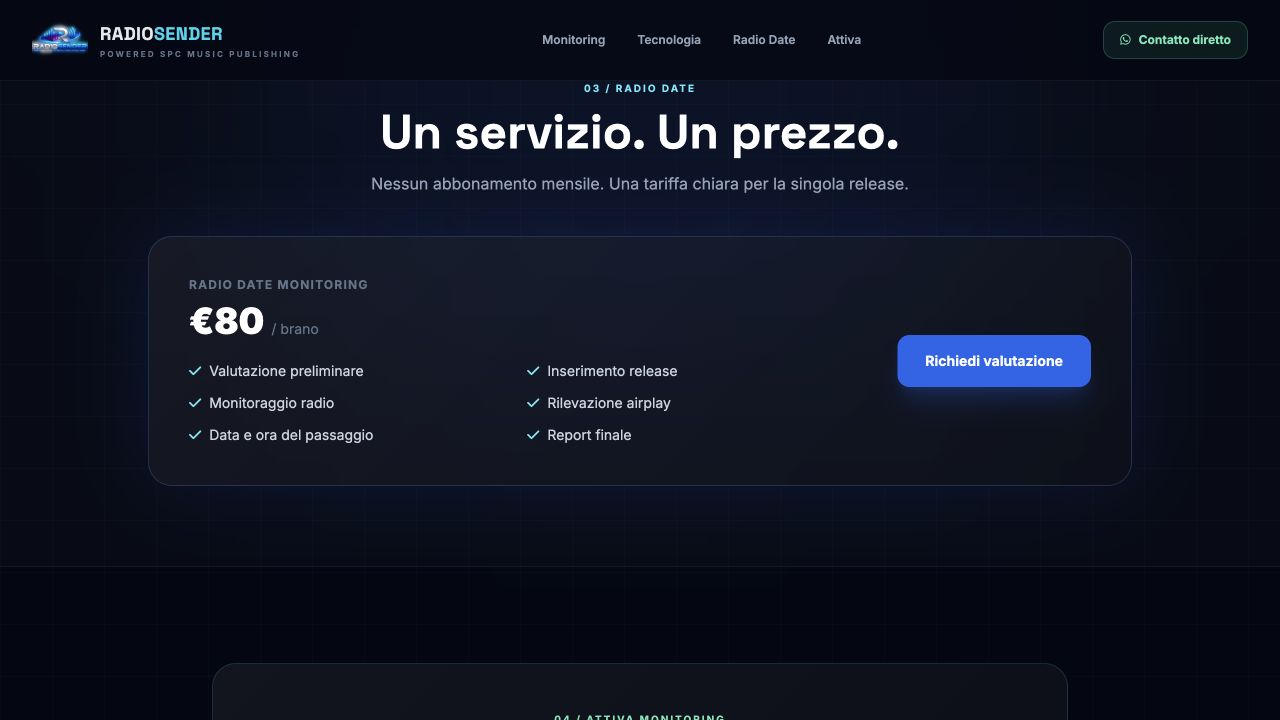
If you offer a paid service, artists must be able to identify the seller and understand the terms. A brand, a contact and a price do not answer those questions. Before buying airplay monitoring, find out about coverage, duration, reports and support: those are the elements needed to assess an offer.
The domain radiosender.it, reported alongside this service, returned an HTTPS certificate error during the check. The screenshots here show the RadioSender page linked from SPC. SPC Music Publishing and RadioSender are not Monitor Radio.
Business identity, tax details and terms are not optional
Let me be clear: in Italy and the European Union, selling services online while omitting mandatory seller identification and contractual information is not permitted. This is not a personal preference or a design detail.
In Italy, Articles 7 and 12 of Legislative Decree 70/2003 require accessible information about the provider: name or legal business name, address, contacts, relevant registration details and a VAT number or equivalent where the activity is subject to VAT. Proposed general terms must be capable of being stored and reproduced. The European framework is set out in Directive 2000/31/EC; consumer sales also involve pre-contract information requirements.
For someone about to pay, a website that does not let them identify the seller is an effectively anonymous storefront. I would not buy until I had the legal identity, applicable tax details and service terms. Their absence from the pages specified is the issue I am raising.
Banks and partners demand rigorous documentation, terms, order handling and checks from my companies. I find it unacceptable that in 2026 artists still have to guess who will receive their money. Rigour cannot be demanded only of those who invest in operating responsibly.
WHOIS data protection can be legitimate; I do not treat it as evidence of wrongdoing. What matters here is the information the seller makes available on its website and before entering a contract.
Before paying, check who you are dealing with
- Legal business name and tax details: these should identify the seller and match the quotation and invoice.
- Terms and conditions: check what you are buying, the duration, the supplier’s obligations and how problems and cancellations are handled. Keep a copy.
- The actual service: sending a track to stations, promoting it and detecting airplay are different services. Ask what is included.
- Group membership: verify the domain through Mantovani Group or links on this website. Resemblance is not affiliation.
Do not buy from anyone who implies they are us when they are not. If in doubt, ask us before paying. Keep offers, receipts, emails and reports: remembering a conversation is no substitute for documentation.
The irony: our White Label service already exists
There is something that makes this situation even more absurd: our group has offered White Label services for years. We can supply platforms bearing a partner’s name and brand, with real data from our systems and documented, verifiable reports. You do not need to copy a storefront to work with our technology.
I find it short-sighted to chase a copy when you can build your own service on an operating infrastructure. Partners can use their own identity, logo and domain. Their customers remain theirs: we supply the agreed technical and operational foundation. That is the model described on the Mantovani Group White Label page.
Digital Delivery under your brand
Our Digital Delivery technology organises music and promotional material delivery to radio contacts, tracking deliveries, opens and downloads. White Label brings that workflow into the partner’s service. The benefit is an organised, reportable operation instead of simply claiming that emails were sent.
Monitoring Radio with data and reports
Monitoring provides information about detected broadcasts: which tracks, on which stations and when. That work is visible on Monitor Radio. Offering it under a partner’s brand gives artists concrete information about their airplay, with coverage and functionality defined for the project.
Digital Distribution for your service
The group’s digital distribution covers delivery to music platforms, catalogue and metadata management, royalties and reporting. White Label allows a service to be organised around the partner’s identity. The benefit is focusing on artists and repertoire without building every technical component from scratch.
The point is straightforward: invest in your own identity, keep your customer relationships and use professional tools through a clear agreement. Services, responsibilities and configuration are defined before launch. You are selling your own service, with an identified operational partner, rather than a resemblance to another company.
If you want to enter this market, let’s discuss the White Label arrangement suited to your business. Building a recognisable company is much smarter than trying to look like somebody else.
Explore Mantovani Group White Label
We will keep investing and highlighting concerns
Supporting independent artists means respecting their work and budget. Money spent badly can mean abandoning a production, a campaign or another opportunity. That is also why we keep investing in tools, people and services.
I will also use this blog to identify websites outside our group and publish situations I believe deserve attention, with names and documentation. Serious competition has my full respect. Confusion built around other people’s work does not.
Paid for a service and something is wrong? Let’s talk.
If you thought you were buying from us, if the service did not match the promises or if you want to understand how to leave a business relationship that is not working, book a meeting with me.
We will examine what you were sold, the documents you have and the results delivered to identify practical steps to protect your project. Where legal action is needed, the appropriate qualified professional must be involved.
Book a meeting with Roberto Mantovani
Copying us may be easy. Building what we have built takes work, investment and responsibility. My message to artists: know who you are trusting.
Public pages and screenshots checked on 9 October 2026 (UTC). Observations concern the specified pages and may be updated with verifiable information. AI-generated editorial cover; genuine screenshots.